

KEY TAKEAWAYS
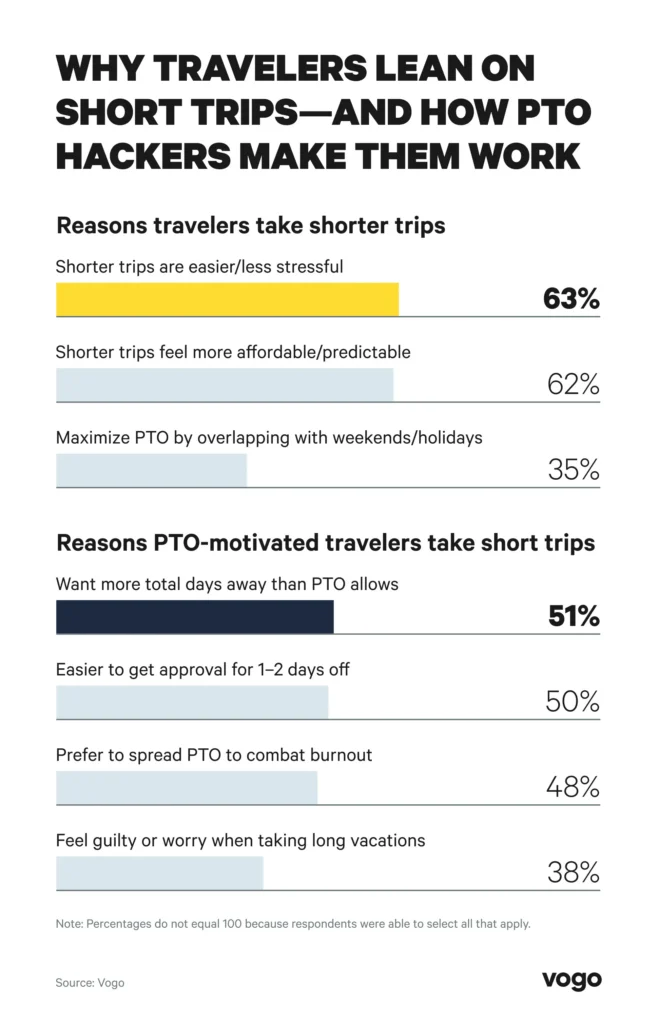
- 63% say they choose shorter trips because they are easier to plan and/or feel less stressful than longer vacations.
- 62% say shorter trips feel more affordable or predictable in cost, so money matters, but is not the only driver.
- 35% say they use shorter trips to maximize PTO by overlapping with weekends or holidays so they can take more getaways across the year.
- Among travelers who use short trips to maximize PTO, 51% say they want more total days away than PTO alone allows, 50% say it is easier to get approval for one or two days off than a full week, and 48% say they use short trips to manage burnout.
Americans are shifting their vacation habits toward frequent two- to three-day getaways. Many now trade one big yearly trip for a series of quick escapes that fit busy schedules and real budgets. These modern getaways offer quick relief from daily demands.
In a new survey of over 1,000 U.S. adults, 43% who do so regularly and 57% who opt for these shorter getaways sometimes. For most, these trips feel simpler, less stressful, and more affordable than the traditional week-long vacation.
Our study looks at how stress, burnout, PTO strategy, and budgets are all pushing travelers toward optimizing shorter breaks. You’ll see why these quick escapes have shifted from “extra” to essential for many people planning their time away.
Short Trips Have Become the Default Vacation for More than 4 in 10 Travelers
Survey findings reveal that short breaks are no longer a niche trend. They are now a baseline behavior. Among the leisure travelers surveyed, 43% taking these trips regularly, it is clear that many people now view a vacation as a string of smaller escapes rather than one single event planned a year in advance.
This shift appears to be driven by practical needs rather than outside influence. Instead of following online trends, most travelers are looking for cheap places to travel that protect their bank accounts and their peace of mind. Only 14% of respondents said that social media inspired them to choose a shorter trip over a longer one.
By choosing shorter durations, travelers can maintain a sense of adventure without the high stakes of a major trip. Whether they are looking for the best romantic getaways or a quick solo break, this pattern shows that the modern vacation is being redesigned to be more frequent and less complicated.
![Chart showing all leisure travelers in the survey take 2–3 day trips, split between “regularly” and “sometimes.”]](https://blog-assets.vacationrenter.com/2026/04/ce66f34d-how-common-are-2-3-day-trips.webp)
Nearly Two-Thirds of Travelers Choose Shorter Trips Because They Are Easier to Plan
For most travelers, the decision to go small is about mental health as much as it is about money. Our study shows that 63% choose shorter trips because they are easier to plan and feel less stressful. Another 62% say these quick escapes feel more affordable or predictable in cost. This combined focus on emotional and financial ease makes the two- to three-day getaway a top choice.
Strategic planning is also helping people get away more often. About 35% of travelers use shorter trips to maximize their PTO by overlapping with weekends or holidays. Among this group, the reasons for “PTO hacking” are remarkably consistent. Around half of these travelers are driven by a mix of three nearly equal pressures:
- A desire for more total days away (51%)
- The ease of getting approval for shorter absences (50%)
- The need to combat burnout (48%)
These patterns show that people are actively designing their time off to fight exhaustion while navigating workplace realities. About 38% of these travelers also admit they opt for shorter stays because they feel guilty taking long stretches off work or worry about the catch-up when they return.
Instead of treating these as extra vacations, many now see them as a necessary way to manage work stress without the heavy “vacation tax” of a mountain of emails and other work upon their return.
Nearly Two-Thirds of Stressed Travelers Say Upfront Costs Are the Hardest Part of Long Trips
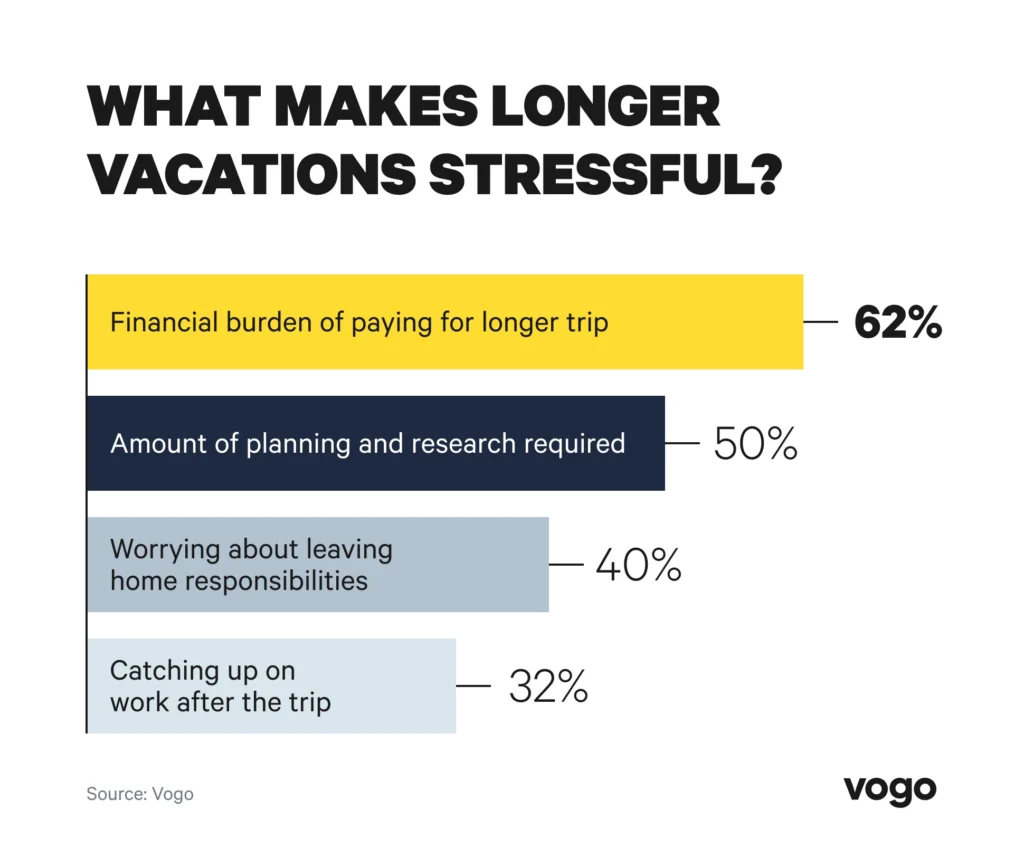
While short getaways offer an easy escape, longer vacations are becoming high-stakes decisions that many people find draining. The impact of rising costs on travel plans is clear. Among those who say longer trips feel stressful, 62% cite the financial burden of paying for a big trip all at once. This upfront cost makes a traditional vacation feel more like a risky investment than a relaxing break.
Logistics also play a major role in the shift toward shorter stays. Half of this group finds the amount of planning and research required for a long trip to be overwhelming.
Travelers often look for ways to lower this hurdle by using curated destination guides, setting strict search filters, or relying on travel platforms that aggregate the best options in one place. These tools help prevent the planning process from becoming an exhausting chore.
Other factors add to the complexity of a week (or more) away. About 40% of travelers worry about leaving home responsibilities like pets or caregiving. For 32%, the stress of catching up on work after a long absence is enough to make them reconsider their plans.
These pressures are pushing travelers toward shorter getaways that demand less effort. By choosing a two- to three-day break, they can manage their total vacation cost without the heavy emotional or financial baggage of a traditional vacation.
More Than 8 in 10 Cap Short Trips Under $500, While Long Trips Are Reserved for Major Investments
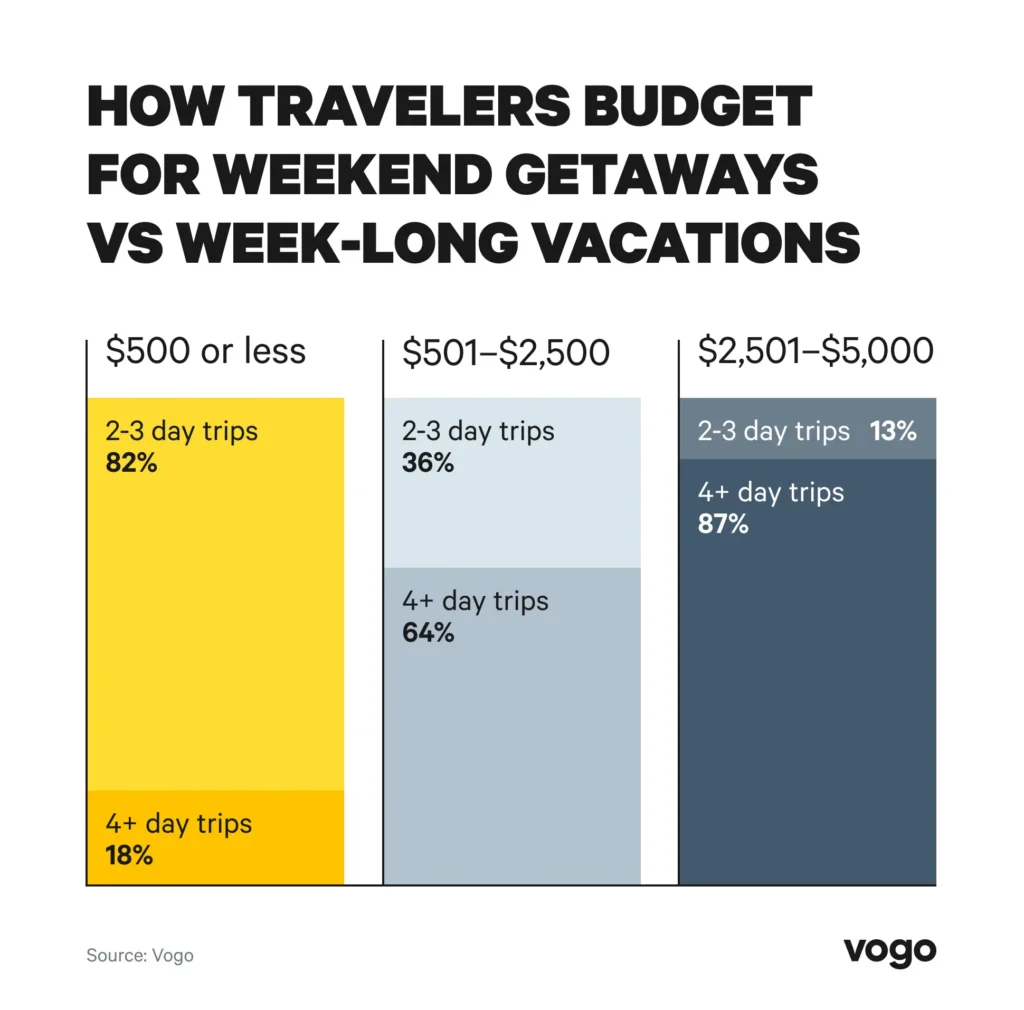
For two- to three-day trips, 82% of travelers say they would spend $500 or less. In contrast, only 18% would keep a longer trip within that same budget. This shows that short stays are generally viewed as low- to mid-spend decisions that do not require the intense financial planning of a week-long vacation.
The spending tiers shift significantly as the trip length increases. About 64% of travelers would spend between $501 and $2,500 on a vacation of four days or more. When the travel budget climbs to the $2,501–$5,000 range, 87% of people reserve those funds for longer stays.
This data confirms that travelers categorize their trips by cost and duration. Most Americans save their largest investments for rare, extended trips. For the rest of the year, they rely on these shorter getaways as repeatable escapes that fit more easily into a standard monthly budget.
What Modern Getaways Mean for Your Next Year of Travel
More travelers are choosing two- to three-day trips because they feel easier to plan and more budget-friendly. These shorter breaks are no longer just an extra perk. They are a tool people use to protect their time, energy, and PTO throughout the year.
Think about how a few well-timed short getaways could fit into your own schedule. Whether it is a quick beach escape or a nature retreat, these trips offer a way to recharge that actually feels doable.
The key to a successful modern getaway is removing the friction that makes traditional travel feel like work. When you are ready to plan, Vogo makes it easy to compare the best stays for your dates and budget in seconds. Our platform handles the research for you so you can spend less time stressing and more time actually getting away.
Methodology
The survey was conducted by Centiment for Vogo. The survey was fielded between March 6, 2026, and March 9, 2026. The results are based on 1,050 completed surveys. In order to qualify, respondents were screened to be residents of the United States and over 18 years of age. Data is unweighted, and the margin of error is approximately +/-3% for the overall sample with a 95% confidence level.